
By Coreless Motor Lab · First recorded · Reviewed
12V Micro Motor Sizing Tool
Size a 12V DC micro motor from loaded speed and torque, then prepare an RFQ. Compare brushed, coreless and brushless requirements with sourced guidance below.
Calculate your load requirements
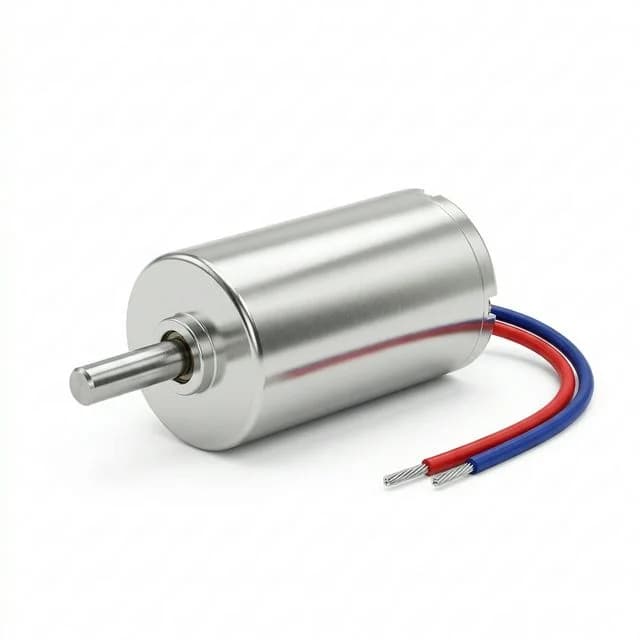

12V DC micro motor selection decisions
Core conclusions are paired with quantifiable context before deep-dive sections.
Speed × torque determines power
No-load rpm and stall torque occur at different operating points. Match both targets on the candidate torque-speed curve.
Manufacturer sourceDRV8833: 2.7–10.8V
This bridge cannot connect directly to a nominal 12V rail. A suitable voltage window still requires current and transient checks.
Manufacturer source10,000 rpm is a no-load example
Pololu 4750 is a 37mm reference, not a micro-frame recommendation. Its speed and 5.5A stall current cannot qualify another motor.
Manufacturer sourceCoreless: low rotor inertia
FAULHABER describes cogging-free brushed coreless motion. Select by part-level dynamics, continuous load and drive requirements.
Manufacturer source- Need shaft-power requirements for a 12V DC micro motor before asking for candidate parts.
- Need broad 12V micro motor screening before deciding whether a direct-drive, pump, brushless, or geared path is appropriate.
- Need brushless quotes with a defined controller scope and evidence for the simultaneous speed and torque requirement.
- Need to scope a brushless pump with fluid, flow, pressure and motor-side startup requirements.
- Need source-backed boundary language for voltage window, surge current, and duty cycle.
- Need to compare a calculated requirement with supplier evidence and plan a sample test.
- Final release decisions without PN-level thermal, endurance, and waveform evidence.
- Safety-critical programs requiring certified reliability packages.
- Projects that require guaranteed noise/backlash targets without matched test fixtures.
- Procurement plans that skip driver-rail and startup-surge validation.
Methods and evidence
Transparent formulas, dated sources, and explicit known/unknown boundaries.
| Method block | Formula / rule | Decision value |
|---|---|---|
| Required shaft power | P (W) = 2π × rpm × torque (mNm) / 60000 | Speed and torque must describe the same loaded shaft operating point; duty does not reduce the instantaneous demand. |
| Ideal supply-current lower bound | I_ideal = P / V, assuming 100% total efficiency | An energy lower bound only. Actual run current requires motor and controller efficiency at this load. Never use it as a supply or driver rating. |
| Startup current and rail droop | N/A until candidate and supply data are known | Request winding resistance, current limiting, load inertia and a startup waveform. Fixed run-current multipliers cannot establish startup current. |
| Heat and duty | N/A without losses and thermal conditions | Supply on/off times, ambient temperature, mounting and cooling. Equal duty percentages can produce different winding temperatures. |
| Review rules used by this tool | Rail ≠12V; speed <3500 or >18000 rpm; duty >70%; non-indoor environment | Editorial prompts for extra review, not universal operating limits. Power >50W or torque >160mNm requests engineering review. No status qualifies a specific part. |
| Candidate checks after calculation | Loaded torque-speed curve + driver window + measured current | Confirm winding voltage, continuous torque, actual peak current and thermal endurance before procurement. Ratio and driver suitability are not computed without a candidate. |
Requested load and cited model-specific catalog limits.
Candidate fit, startup waveform, temperature rise and endurance at your duty.
| Source | Date | Coverage | Known / Unknown |
|---|---|---|---|
| Pololu 4750 (1:1 no-gearbox 12V 37D) | Accessed 2026-05-06 | No-gearbox point: 10,000 rpm no-load, 200 mA no-load, 0.5 kg*cm stall torque, 5.5 A stall current. | Known |
| Pololu 4747 (6.3:1 12V 37D) | Accessed 2026-05-06 | Low-ratio point: 1600 rpm no-load, 200 mA no-load, 3.0 kg*cm stall torque, 5.5 A stall current. | Known |
| Pololu 2829 (150:1 12V 37D) | Accessed 2026-05-06 | High-ratio counterpoint: 67 rpm no-load, 200 mA no-load, 49 kg*cm stall torque, 5.5 A stall current. | Known |
| Pololu 37D merged comparison table (rev. 2026-04) | Accessed 2026-05-06 | Same 12V motor platform spans 1:1 (10,000 rpm) to 150:1 (67 rpm); stall values are extrapolation markers. | Known with family scope |
| Mabuchi RF-370CA-15370 product page | Accessed 2026-05-06 | 12V brushed anchor: 5600 rpm no-load, 0.026 A no-load current, 18.3 mN*m stall torque, 1.06 A stall current. | Known |
| TI DRV8876 datasheet | Accessed 2026-05-06 | Operating window 4.5V-37V; UVLO rises around 4.45V and falls around 4.35V in electrical-characteristics tables. | Known |
| TI DRV8833 datasheet (Rev. E) | Accessed 2026-05-06 | Operating window 2.7V-10.8V; VM UVLO falling threshold 2.6V with ~90 mV hysteresis. | Known |
| TI DRV8212 datasheet (Rev. B) | Accessed 2026-05-06 | Low-voltage bridge with a 1.65V-11V operating range. UVLO limits are supply- and package-specific; use the electrical-characteristics table, not a nominal trip assumption. | Known |
| Directive 2011/65/EU (RoHS) | Current version accessed 2026-05-06 | RoHS baseline restriction framework and Annex references. | Known |
| Delegated Directive (EU) 2015/863 | Accessed 2026-05-06 | Annex II update introducing additional phthalate restrictions. | Known |
| ECHA SCIP database guidance page | Accessed 2026-05-06 | SCIP obligations from 2021-01-05 and trigger context for Candidate List substances above 0.1% w/w in articles. | Known with jurisdiction scope |
| ECHA Candidate List package page | Accessed 2026-05-06 | Shows current SCIP reference package cadence (for example February 2026 package label). | Known with package-scope boundary |
| ECHA news: Delays in the SCIP Dissemination process | Published 2026-01-29, accessed 2026-05-06 | Confirms dissemination timing can be delayed, so portal visibility is not a real-time submission proof. | Known with process-timing scope |
| On-page requirements calculation | Reviewed 2026-09-20 | Power conversion and ideal energy lower bound; review flags are editorial heuristics, not calibrated fit predictions. | Known |
| Cross-vendor endurance/backlash comparability dataset | Pending | No unified public dataset across matched duty and fixture protocols. | Pending confirmation / evidence gap |
| Funtain Motor RS-775PH-7417 datasheet | Accessed 2026-06-19 | RS-775PH-7417 example: 12V nominal, 12,000 rpm no-load, 1.55A no-load, 10.90A at maximum efficiency, and 75.60A stall current. | Known with model-specific scope |
| RIC Motor RIC-12GB1215 12mm DC gearmotor | Accessed 2026-06-19 | N20/12mm gearmotor output speed is specified as a gearmotor output range (1 rpm to 2000 rpm custom), not as a fixed 12,000 rpm output shaft. | Known with vendor-scope boundary |
| ServoCity Premium N20 Gear Motor 298:1 | Accessed 2026-06-19 | A 12V N20 example with 298:1 gearbox lists 90 rpm no-load output speed, demonstrating ratio-driven output-speed reduction. | Known with vendor-scope boundary |
| FAULHABER DC Motors Technical Information | 19th edition 2026 (accessed 2026-06-25) | Precious-metal commutation is positioned for continuous duty near highest-efficiency points, while graphite commutation is better suited to dynamic high-power / periodic-overload duty; typical life is class-level and profile-dependent. | Known with scope |
| FAULHABER DC Motors Technical Information | 19th edition 2026 (accessed 2026-06-25) | PWM control guidance recommends a switching frequency at or above 20 kHz for brushed DC motor control planning. | Known with scope |
| TI BLDC motor driver selection guide | Accessed 2026-07-18 | Brushless systems need controller/driver decisions; TI positions integrated sensorless BLDC drivers as a way to reduce software effort and external sensor needs in some applications. | Known with vendor-application scope |
| TI Hall-effect BLDC commutation note | Accessed 2026-07-18 | Hall-sensor BLDC control uses rotor-position feedback to determine commutation timing, making sensor population a quote-scope item rather than an afterthought. | Known with control-method scope |
| Public BLDC quote-market evidence gap | Reviewed 2026-07-18 | No normalized public market MOQ or price dataset is retained for custom 12V micro BLDC quotes. Treat MOQ, unit price, NRE, driver inclusion, and lead time as supplier-specific N/A fields until a quote answers them. | Public evidence insufficient / market median N/A |
| TOPSFLO TL-B10 brushless DC centrifugal pump page | Accessed 2026-07-23 | 12V/24V brushless centrifugal pump example with rated voltage, flow/head fields, brushless DC motor, liquid compatibility notes, and explicit "cannot dry-run / not self-priming" boundary. | Known with vendor/model scope |
| TOPSFLO 12V/24V brushless direct drive pump page | Accessed 2026-07-23 | Vendor page lists 12V/24V brushless direct-drive pump range, flow/head/fluid fields, lifetime claims, PWM/0-5V control, FG signal, and dry-running protection as specification items. | Known with vendor/application scope |
| KNF liquid diaphragm pump technology page | Accessed 2026-07-23 | Diaphragm liquid pumps are described as self-priming and safe for dry running, with flow/pressure/suction-height ranges and customizable hydraulic/electrical interfaces. | Known with architecture/vendor scope |
| Public pump lifespan and derating comparison gap | Reviewed 2026-07-23 | No normalized public curve is retained for universal 70-80% capacity, 10V-on-12V derating, or cross-vendor dry-run lifetime claims. Keep those as supplier-approved settings only. | Public evidence insufficient / PN-specific N/A |
| Pololu: Dealing with Motor Noise | Accessed 2026-09-20 | Pololu describes 0.1µF non-polarized ceramic suppression capacitors close to the motor. Component voltage rating and the final network need circuit-specific transient and EMC validation. | Vendor guidance; not a compliance guarantee |
| FAULHABER: Brushed DC motor design | Accessed 2026-09-20 | FAULHABER describes its ironless rotor as low-inertia and cogging-free. Compare candidate inertia and inductance values; no universal acceleration or efficiency advantage is quantified here. | Manufacturer design explanation |
Selection evidence and limits
Only net-new, source-verifiable information is included here. Each row states scope and decision consequence.
| Topic | New fact | Applicable condition | Decision effect | Certainty |
|---|---|---|---|---|
| 12V ratio spread evidence | Within one 12V 37D platform, published sample points span 10,000 rpm (1:1) to 67 rpm (150:1), while torque endpoints invert from 0.5 to 49 kg*cm (stall extrapolation). | Applies when users search by voltage only and omit ratio. | Treat ratio as a required decision variable instead of selecting by voltage label alone. | Known with vendor scope |
| Direct-drive 12V anchor | Public 12V direct-drive samples include Mabuchi RF-370CA-15370 (5600 rpm no-load, 1.06 A stall) and Pololu 4750 no-gearbox point (10,000 rpm no-load, 5.5 A stall). | Applies when users request very high rpm but rely only on generic catalog labels. | Evaluate speed targets together with current and torque envelopes; direct-drive speed points alone are not a sufficient fit signal. | Known with source-specific scope |
| Driver-window mismatch risk | DRV8876 supports 4.5V-37V (UVLO around 4.45V rising), while DRV8833 supports 2.7V-10.8V (UVLO falling 2.6V). | Applies when legacy low-voltage boards are reused on 12V programs. | Add explicit bridge-window gates and fallback actions near results. | Known |
| Low-voltage fallback clarification | DRV8212 provides a 1.65V-11V operating window; consult package-specific VM/VCC undervoltage limits. It is not suitable for a direct nominal 12V rail. | Applies when project rails dip below standard low-voltage driver windows. | Mark low-rail paths as conditional until waveform validation is complete. | Known with boundary |
| Stall-number misuse boundary | Pololu explicitly marks stall values as extrapolation and warns stalls can damage brushed motors; public guidance also recommends continuous current around <=25% of stall as a heuristic. | Applies when shortlist decisions rely on catalog stall torque/current without duty context. | Treat stall points as boundaries only and require continuous-current thermal validation before approval. | Known with vendor-heuristic scope |
| Compliance trigger clarity | RoHS base directive plus Annex updates remain active, and SCIP notifications apply from 2021-01-05 for Candidate List SVHC content >0.1% w/w in EU-market articles. | Applies to EU market articles and electrical product supply chains. | Promote compliance checks to decision-gate status before production RFQ release. | Known with jurisdiction scope |
| SCIP dissemination timing caveat | ECHA published a dissemination-delay notice on 2026-01-29, indicating public records can lag behind submissions. | Applies when teams use the public SCIP portal as their only compliance evidence checkpoint. | Track submission UUID/receipt internally and do not block release solely on temporary portal-visibility lag. | Known with process-timing scope |
| RS-775 extreme stall current | A published RS-775PH-7417 example lists 12V, 12,000 rpm no-load, and 75.60A stall current. | Applies when users select the 775 frame size for high torque applications without checking power supply or driver limits. | Highlight stall current as a major system design risk and require high-current drivers or strict current limiting. | Known with vendor scope |
| N20 gearmotor speed rating mismatch | Public N20/12mm gearmotor examples list output speed as a ratio-dependent gearmotor speed, such as 1-2000 rpm custom or 90 rpm at 12V for a 298:1 gearbox. | Applies when users source N20 gearmotors based on generic title text. | Add a boundary warning to clarify internal vs. output RPM for gearmotors. | Known |
| Brush material mismatch risk | FAULHABER technical guidance positions precious-metal commutation for continuous duty near the highest-efficiency operating point and graphite commutation for dynamic high-power / periodic-overload duty. | Applies when selecting brushed motor paths for high start-stop frequency, reversing, high torque pulses, or long-life duty targets. | Require commutation material disclosure during RFQ and map precious-metal vs graphite selection to duty cycle, overload profile, and life target. | Known with scope |
| PWM frequency planning boundary | FAULHABER technical guidance recommends PWM control at or above 20 kHz for brushed DC motor control planning. | Applies when speed control is implemented through PWM on brushed/coreless micro motors. | Specify controller PWM frequency in the RFQ and validate thermal/noise impact during sample bring-up instead of leaving PWM settings implicit. | Known with scope |
| Brushless Driver Integration Boundary | 12V brushless micro motors require commutation electronics. Integrated sensorless drivers can reduce software and sensor burden in some applications, while Hall-based systems require sensor population and commutation planning. | Applies when moving from brushed to brushless for longevity or efficiency. | Explicitly specify whether the quote includes an integrated driver or requires an external ESC, and whether Hall sensors are included. | Known with driver-control scope |
| BLDC MOQ and Quote Scaling | Public evidence supports vendor-specific quote variation, not a universal market MOQ: sample price, pilot quantity, mass-production tier, NRE/tooling, controller inclusion, and lead time must be quoted explicitly. | Applies to procurement planning for brushless micro dc motor quotes. | Treat MOQ and cost as N/A until the supplier states sample, pilot, and production tiers separately from any driver or tooling charge. | Known with vendor-specific scope; market median N/A |
| Pump thermal equilibrium and dry-running | Published pump pages show dry-run behavior is architecture and PN specific: one 12V/24V centrifugal example explicitly says it cannot dry-run, while KNF diaphragm-liquid-pump guidance describes self-priming and dry-running capability. | Applies when selecting 12V brushless micro motor pumps for continuous or variable-fluid applications. | Add flow/head, fluid, dry-run/self-priming, PWM or FG/tach, and protection behavior to the RFQ. Treat voltage derating or capacity-limit advice as supplier-approved only. | Known with source-specific scope; universal lifespan rule N/A |
| EMI Suppression for 12V Brushed MotorsSource | Pololu recommends 0.1µF non-polarized ceramic capacitors near brushed motor terminals to reduce commutation noise; this is a starting point for circuit testing. | Applies when using 12V brushed DC motors in systems sensitive to RF interference or subject to strict CE/FCC EMC regulations. | Keep connections short; verify voltage rating, PWM compatibility and emissions in the final system. Neither a universal 100V rating nor a 10mm limit is established by this source. | Pololu application guidance; system validation required |
| Coreless vs Iron-core DynamicsSource | FAULHABER describes low rotor inertia and cogging-free motion for its coreless brushed designs. Actual dynamics require the selected rotor and load inertia. | Applies when rapid acceleration/deceleration, smooth low-speed motion, or low electrical time constants are required. | Compare coreless and iron-core candidates using continuous torque, inertia, inductance, controller compatibility and quoted system cost. | Manufacturer explanation; no normalized cross-vendor ranking |
| Evidence point | Architecture role | Published data | Decision use |
|---|---|---|---|
| Pololu 4750 (37D 1:1 no-gearbox, 12V) | No-gearbox direct-drive boundary point | 10,000 rpm no-load, 200 mA no-load, 0.5 kg*cm stall torque, 5.5 A stall current | Shows that high no-load rpm is feasible on 12V only when torque boundary is low and current spikes are managed. |
| Mabuchi RF-370CA-15370 (12V) | Compact brushed direct-drive anchor | 5600 rpm no-load, 0.026 A no-load current, 18.3 mN*m stall torque, 1.06 A stall current | Provides a second 12V direct-drive anchor from another vendor to avoid single-source bias. |
| Pololu 4747 (37D 6.3:1, 12V) | Low-ratio geared 12V fallback path | 1600 rpm no-load, 200 mA no-load, 3.0 kg*cm stall torque, 5.5 A stall current | Shows how gearing trades output speed for torque; check gearbox continuous and peak ratings. |
| Pololu 2829 (37D 150:1, 12V) | High-ratio geared boundary path | 67 rpm no-load, 200 mA no-load, 49 kg*cm stall torque, 5.5 A stall current | Counterexample for high-speed queries: same 12V rail can resolve to very low rpm when ratio is high. |
| Pololu 37D family table | Same voltage, multi-ratio spread | 12V family spans no-gearbox/high-speed points to high-ratio/low-speed points within one platform family | Prevents single-number selection errors from voltage-only queries. |
| Generic RS-775 12V | Large brushed direct-drive anchor (power tool class) | RS-775PH-7417: 12,000 rpm no-load, 1.55A no-load current, 84.00 mNm at maximum efficiency, 75.60A stall current | Demonstrates the extreme high-current boundary for "12V rpm" in larger frame sizes. Driver selection must be sized from stall and startup current, not title rpm. |
| Gate | Threshold | Required action if not met |
|---|---|---|
| 12V bridge window gate | Driver operating rail must cover system voltage plus transient margin (DRV8876 4.5V-37V; DRV8833 2.7V-10.8V; DRV8212 1.65V-11V). | If window mismatch exists, switch bridge family before RFQ freeze. |
| UVLO recovery gate | After startup/braking droop, VM must recover above UVLO rising threshold (example: DRV8876 typ 4.45V, DRV8212 1.65V; DRV8833 has only falling-point disclosure). | Capture startup waveforms and validate no reset-loop behavior on target harness. |
| Surge-current gate | Modeled startup current exceeds driver/OCP or supply-path margin. | Upsize motor path, update bridge, or reduce startup load before committing design. |
| Brushed-duty gate | High duty (>=70%) with high rpm (>=10000) or high torque demand; treat catalog stall points as non-continuous ratings. | Move output to conditional state and require thermal/endurance evidence plus continuous-current confirmation. |
| EU compliance gate | RoHS Annex requirements and SCIP trigger when Candidate List SVHC is >0.1% w/w in articles (submission obligation effective 2021-01-05). | Require material declarations and SCIP readiness before production release. |
| SCIP evidence gate | Portal dissemination may lag behind submission (per ECHA delay notices). | Keep SCIP submission UUID/receipt in release checklist; do not use portal visibility alone as pass/fail proof. |
| Driver current matching gate | If selecting an RS-775PH-class 12V rpm high-power motor, published stall current can reach 75.60A for a specific 12V model. | Mandate appropriate high-current motor drivers (e.g., discrete MOSFET bridges) and ensure power supply can handle surge without shutting down. |
| Brush material selection gate | High start-stop frequency, reversing, dynamic high-power, or periodic overload points toward graphite commutation; continuous duty near highest-efficiency points can fit precious-metal commutation. | Document the expected load profile and request commutation material disclosure in the RFQ before locking speed, torque, warranty, or life claims. |
| PWM frequency control gate | PWM control should be specified and validated against a >=20 kHz planning boundary unless the selected motor/driver supplier approves another profile. | Validate controller switching frequency, current ripple, thermal rise, and acoustic behavior during sample bring-up. |
| Brushless Quote Scope Gate | When requesting 12V brushless micro DC motor quotes, the driver topology (integrated vs external, sensored vs sensorless) must be defined. | Reject quotes that do not explicitly state whether the controller is included or if Hall sensors are populated. |
| Brushless MOQ and NRE Evidence Gate | Quote must separate sample quantity, pilot quantity, production MOQ, unit price tier, NRE/tooling, controller cost, and lead time. | Mark MOQ/cost as N/A and request a revised quote if any tier is bundled or missing. |
| Pump dry-running architecture gate | If the fluid system may run dry, a centrifugal pump must show PN-level dry-run approval or protection; at least one cited 12V/24V centrifugal example explicitly says it cannot dry-run. | Specify dry-run protection, fluid-presence sensing, or a diaphragm/liquid-pump architecture whose datasheet confirms self-priming and dry-running capability. |
| Quote field | Supplier answer required | Why it changes the decision |
|---|---|---|
| Driver topology | Integrated driver, external ESC, or customer-supplied bridge/control board. | Changes wiring, firmware ownership, peak current limit, available protection, and quote comparability. |
| Sensor population | Hall sensors included, sensorless only, encoder option, or N/A. | Low-speed startup, speed-loop stability, connector pinout, and BOM cost depend on this choice. |
| Electrical limits | Rated voltage range, no-load speed/current, rated torque/current, peak current, and thermal limit. | Prevents comparing a bare motor quote against a current-limited integrated-driver quote. |
| Commercial tiers | Sample price/quantity, pilot MOQ, production MOQ, unit-price tiers, NRE/tooling, and lead time. | BLDC quote cost is supplier-specific; missing tiers should stay N/A instead of becoming a market claim. |
| Evidence package | Datasheet, winding option, driver datasheet, waveform/thermal sample report, RoHS/REACH evidence. | Keeps pre-RFQ screening separate from final supplier qualification. |
| System consideration | Impact on motor selection |
|---|---|
| Duty cycle & thermal limits | Continuous pump duty must be confirmed at the selected flow/head, ambient, and fluid temperature. External drivers can improve thermal placement, but voltage derating, capacity limits, and lifetime gains must be supplier-approved settings, not assumed market rules. |
| Torque stability and startup surge | Fluid viscosity and head pressure can raise startup torque and current. Ask for rated current, peak or locked-rotor behavior, controller current limit, and startup waveform evidence so the 12V supply does not sag into reset or twitch behavior. |
| Dry-running capability | Do not assume dry-run safety from the word brushless. A cited centrifugal pump page says it cannot dry-run, while diaphragm liquid pumps may be self-priming and dry-running when the supplier specifies it. Put dry-run duration and protection behavior in the RFQ. |
| Flow rate control (PWM) | Flow control may use PWM, 0-5V input, FG/tach feedback, or a closed loop depending on the pump driver. Confirm the signal interface, rpm range, minimum stable flow, and whether reduced-speed operation is approved for the target fluid. |
| Fluid and materials | Pump pages specify fluid compatibility and temperature as first-order fields. Add medium, viscosity, temperature, wetted materials, food/medical constraints, and seal/leakage expectations before comparing motor quotes. |
| Open question | Why evidence is insufficient | Decision impact |
|---|---|---|
| Cross-vendor high-duty endurance curves under matched load fixtures. | Public sources do not provide normalized life data across motor families and test rigs. | Lifetime promises must remain conditional until supplier evidence is attached. |
| Brush wear and commutation heat growth above 12k rpm in repeated cycles. | Most public listings provide nominal speed/current points but not cycle-life at elevated rpm. | Reliability claims at high speed remain conditional until PN-level endurance traces are provided. |
| Thermal derating map for identical load across multiple housings and ambients. | Comparable public thermal datasets are sparse and inconsistent. | High-duty recommendations require bench data before final lock-in. |
| Driver retry behavior under repeated near-UVLO events in final wiring harness. | Application-specific wiring and supply impedance dominate this outcome. | Control stability risk remains until waveform validation is completed. |
| Universal pump derating and dry-run lifespan curves. | Public sources show pump behavior is architecture and PN specific; no normalized cross-vendor curve supports one universal 70-80% capacity or 10V derating rule. | Pump life and dry-run claims must remain conditional until the selected supplier confirms the exact operating profile. |
| Cross-jurisdiction mapping from REACH article-level evidence to non-EU shipment declarations. | Public guidance is fragmented across jurisdictions and often lacks one-to-one evidence templates. | Global launch documentation can still block procurement timing without legal-review alignment. |
Alternative comparison
Use reproducible dimensions (voltage, torque, response, cost, fit) instead of generic claims.
Qualitative comparison only. Cost and response depend on the part, controller and test fixture; no cross-vendor performance scores are available.
| Option | Voltage band | Torque band | Dynamic response | Cost class | Best-fit scenario | Boundary / counterexample |
|---|---|---|---|---|---|---|
| Direct-drive 12V high-speed brushed/coreless path | N/A — selected winding required | N/A — loaded curve required | Fast | Low to medium | Best when high rpm and light-to-medium load dominate the requirement. | Duty, brush wear, and startup surge margins become critical at elevated rpm. |
| 12V micro gearmotor (N20/mini class) | N/A — selected winding required | N/A — gearbox rating required | Medium | Medium | Useful fallback when direct-drive cannot hold target torque with acceptable heat. | Gear wear and backlash risk increase under high reversal shock loads. |
| 12V 37D metal gearmotor class | 12V nominal | 3-49 kg*cm stall extrapolation range by ratio | Medium | Medium to high | Strong option for higher torque demand with broad ratio coverage | Current and thermal envelopes must be validated; stall values are extrapolation points and continuous current should be derated heavily. |
| Mini BLDC with external controller | N/A — motor and controller specific | application dependent | Fast | Medium to high | Useful for longer life and tighter control in higher-duty programs | Controller complexity and BOM increase are non-trivial tradeoffs. |
| RS-775 brushed 12V motor | 12V for the cited RS-775PH example | 84 mNm at max-efficiency point in one 12V RS-775PH example; stall torque is much higher | Fast | Low to Medium | Power tools, heavy robotics, when high torque and high speed are simultaneously needed at 12V. | Can draw massive current (75.60A stall in one cited 12V RS-775PH model) and requires significant cooling and large drivers. |
| 12V BLDC with Integrated Driver | 12V nominal | N/A — frame and controller specific | Fast (simplified wiring, similar to brushed) | High | Compact subsystems needing long life where external ESC placement is impossible. | Controller limits peak current/thermal envelope; less tunable than external drivers. |
Risk and mitigation
Covers misuse risk, cost risk, and scenario mismatch risk with direct mitigation actions.
Impact and likelihood below are qualitative editorial priorities, not measured failure probabilities. Reassess them using your system and test data.
| Risk | Impact | Probability | Mitigation path |
|---|---|---|---|
| Selecting by voltage label only without ratio context | High | High | Force ratio/speed/torque triples in RFQ intake and tool interpretation. |
| Bridge voltage-window mismatch on a 12V rail | High | Medium | Validate operating window and UVLO behavior before board reuse decisions. |
| Startup surge underestimated versus driver and supply path | High | Medium | Reserve surge headroom and verify startup waveforms on representative harnesses. |
| High-duty thermal rise not captured during shortlist stage | Medium | Medium | Run thermal instrumentation and duty-cycle pilot tests on shortlisted PNs. |
| Treating stall extrapolation numbers as continuous ratings | High | Medium | Use stall values only as boundary markers and enforce continuous-current verification. |
| Lifecycle/noise promises made without matched evidence | Medium | Medium | Request vendor endurance and acoustic reports under comparable fixtures. |
| EU compliance checks postponed until after RFQ release | High | Medium | Run RoHS and SCIP document gates before sourcing freeze. |
| Treating SCIP portal visibility as proof of submission status | Medium | Medium | Store submission UUID/receipt from IUCLID/ECHA workflow and track dissemination lag separately. |
| Fallback path missing for boundary-state results | Medium | Low | Map each output state to a concrete engineering next step and CTA. |
| Blowing up standard 2A drivers with an RS-775 10000 rpm motor | High | High | Size motor drivers for model-specific stall/startup current; one 12V RS-775PH reference lists 75.60A stall current. |
| Assuming "10000 rpm" on an N20 listing is the output speed | Medium | High | Verify gear ratio and output rpm; N20/12mm gearmotor examples show output speeds far below 10000 rpm after reduction. |
| Treating vendor-specific BLDC quote terms as a market-wide MOQ or price rule | Medium | Medium | Record MOQ, NRE, driver inclusion, and lead time as supplier-stated values; use N/A until a quote answers each tier. |
| Running a centrifugal 12V micro pump dry | High | Medium | Verify PN-level dry-running approval, use diaphragm architecture only when the datasheet confirms it, or add fluid-presence/protection sensing. |
| Inadequate power supply for pump startup surge | High | High | Size the power supply from supplier-stated peak or locked-rotor current and confirm startup waveforms, not just rated operating current. |
Scenario examples
Illustrative engineering scenarios, not validated fit predictions. Board and battery details below are additional evidence outside the calculator inputs.
| Scenario | Assumption | Estimated result | Action |
|---|---|---|---|
| Portable blower drive | 12V rail, 11000 rpm target, 18 mNm, 30% duty | 20.73W shaft requirement; compare candidate curves and obtain startup data. | Validate startup and steady-state current on two direct-drive candidates. |
| Fast indexing module with moderate load | 12V rail, 9000 rpm target, 70 mNm, 60% duty | 65.97W shaft requirement triggers engineering review; confirm frame size and continuous ratings. | Shortlist two winding/ratio options and run thermal/duty pilot tests before lock-in. |
| Low-speed compact mechanism | 12V rail, 2000 rpm target, 40 mNm, 35% duty | 8.38W shaft requirement; compare a low-speed winding with a geared path. | Verify the selected winding or gear ratio at the loaded operating point; do not infer ratio from voltage alone. |
| Legacy low-voltage board reused on 12V system | 12V rail proposed with DRV8833-class window (max 10.8V) | Not recommended due rail-window mismatch risk. | Move to a 12V-capable bridge class and revalidate startup transients. |
| Battery-powered high-rpm mobile mechanism | 11V-12.6V battery rail, 14000 rpm target, 35 mNm, 45% duty | Conditional with surge and UVLO recovery validation required. | Capture startup/braking waveforms and verify no reset behavior across SOC range. |
| High-load, high-rpm request | 12V rail, 18000 rpm target, 150 mNm, 85% duty | 282.74W shaft requirement triggers engineering review; no compact part has been qualified. | Review a larger motor or changed load requirement; gearing cannot reduce required shaft power. Obtain part-specific endurance evidence. |
Choose your next step
Continue from load requirements to controller scope, pump requirements, or a geared output calculation.
Decision FAQ
Questions are grouped by intent, not glossary-only definitions.
Intent and architecture
What can I calculate before choosing a motor?
Calculate shaft power from simultaneous loaded speed and torque. Use the result to request candidates; current, temperature and lifetime require part-specific evidence.
What does a 12V DC micro motor selection need?
Start with loaded shaft speed, torque, duty cycle and the full supply range. This tool calculates shaft power and prepares requirements for brushed, coreless or brushless candidates. Pump projects also need fluid, flow and pressure; geared projects need loaded output speed and gearbox limits.
How should I size a 12v dc gear micro motor?
Use /learn/12v-micro-gear-motor for the geared workflow. Start with target output rpm and load, then verify gear ratio, gearbox efficiency, duty cycle, shaft load, and driver current.
Why compare direct-drive and geared paths on the same page?
Because voltage alone does not determine output behavior. Ratio and load can dominate speed and torque outcomes.
I found an N20 gearmotor labeled "12V RPM". Will the shaft spin that fast?
Do not assume that. Verify the gear ratio and published output rpm. For example, a 298:1 N20 gearmotor can be listed at 90 rpm output at 12V, while custom 12mm gearmotor ranges may top out around 2000 rpm output.
Can I use a standard DRV8833 or L298N for an RS-775 12V RPM motor?
No, it is highly discouraged. One published 12V RS-775PH reference lists 75.60A stall current, far beyond small 2A-5A drivers.
Can this page replace supplier qualification?
No. This page is pre-RFQ screening support. Final release still requires PN-level validation evidence.
Does the result qualify a motor?
No. Requirements prepared means the inputs can be used in an RFQ. Additional checks and engineering review identify missing evidence or demanding loads. There is no calibrated confidence score or automatic part approval.
Why keep explicit uncertainty sections?
Explicit uncertainty prevents false precision and clarifies what evidence is still required.
Tool boundaries and output use
What input range is supported?
The estimator supports 6V-24V, 1000-30000 rpm, 2-220 mNm, and 5%-100% duty cycle.
When does the tool request additional checks?
A non-12V rail, speed below 3500 or above 18000 rpm, duty above 70%, or a humid/hot environment triggers additional checks. This is a review checklist, not a fit rating.
When does the tool request engineering review?
Shaft power above 50W or torque above 160mNm triggers an editorial review flag. These thresholds are not universal motor limits and do not prove a design is infeasible.
Does the output include uncertainty and next actions?
Yes. Each result includes boundary notes and a state-specific next-step CTA.
Is the model deterministic?
Yes for identical inputs. It is deterministic screening logic, not a substitute for bench tests.
RFQ and compliance execution
What data should be sent in RFQ packages?
Include rail voltage, speed target, torque target, duty cycle, startup profile, ambient conditions, and controller constraints.
What must a 12V brushless micro DC motor quote specify?
The quote must state driver topology, whether Hall sensors or encoder feedback are included, voltage/current limits, sample and production MOQ, NRE/tooling, lead time, and compliance evidence. If any item is missing, treat that field as N/A and request a revised quote.
Can brushed and brushless quotes be compared only by rpm and torque?
No. A brushed motor quote, a bare BLDC motor quote, and an integrated-driver BLDC quote carry different electronics, firmware, current-limit, and validation responsibilities. Compare them only after controller inclusion and sensor scope are normalized.
What minimum test set is recommended before pilot release?
Run startup surge waveform capture, loaded-speed stability checks, thermal-rise testing, and duty-cycle endurance checks on shortlisted parts.
How should stall-current numbers be used?
Treat them as boundary markers only. Do not treat extrapolated stall points as continuous operating ratings.
What are the key EU compliance checkpoints mentioned here?
RoHS restrictions and SCIP trigger context for Candidate List substances above 0.1% w/w in applicable article supply chains.
What is the fallback when engineering review is needed?
Review frame size, winding and load requirements with engineering; a gearbox changes speed and torque but does not eliminate shaft-power demand.
12V brushless micro motor pump applications
Can I run my 12v brushless micro motor pump continuously?
Only if the selected pump PN is rated for that duty at your flow, head or pressure, fluid, and ambient temperature. Treat the page result as motor-side pre-RFQ screening and ask the supplier for continuous-duty thermal evidence.
What happens if a 12v brushless micro motor pump runs dry?
Dry-run behavior is architecture and PN specific. A cited centrifugal brushless pump example says it cannot dry-run, while diaphragm liquid pumps may be specified as self-priming and dry-running. Put dry-run duration and protection behavior in the RFQ.
Why does my 12V brushless pump twitch at startup?
A likely cause is rail droop during peak startup current, especially with viscous fluid or high head pressure. Ask for rated current, peak or locked-rotor current, controller current limit, and a startup waveform before freezing the 12V supply.
How can I extend the lifespan of a 12V brushless pump?
Use supplier-approved derating, PWM or 0-5V speed control, dry-run protection, compatible wetted materials, and validated thermal margins. Do not treat 70-80% capacity or 10V-on-12V operation as universal rules without PN-level evidence.
B2B application fit, OEM options, and inquiry handoff
Move from estimator output to executable sourcing with factory customization scope and compliance-ready RFQ preparation.
- Engineering and sourcing teams comparing 12V brushed, coreless and brushless motor candidates.
- Programs deciding whether rpm stability should come from direct-drive control loops, geared derating, or a 12V micro gearmotor path.
- Buyers who need a fast shortlist before RFQ while keeping compliance and risk gates visible.
- Winding/Kv and ratio options tuned around the 12V rail and target output band.
- Shaft form, lead-wire, connector, and mount adaptations for integration constraints.
- Encoder and harness options for closed-loop speed control or diagnostics.
- Collect RoHS/REACH declarations and material evidence before production commitment.
- If Candidate List SVHC content exceeds 0.1% w/w in EU market articles, prepare SCIP notification artifacts.
- Keep SCIP submission UUID/receipt as audit evidence because public dissemination can lag.
- Verify startup surge, thermal rise, and duty-cycle behavior on sample PNs before release.
- Treat this page as pre-RFQ decision support, not final qualification evidence.
Related fit checks